Current Bitcoin Price

Showing posts with label Bitcoin Magazine. Show all posts

Thursday, November 21, 2019

Op Ed: HODLing Bitcoin? Cold Storage Is Worth the Extra Effort

Bitcoin’s popularity is growing among institutions and private investors alike as they better understand its value proposition as a store of value and as a means for censorship-resistant payments. As the value of bitcoin is progressing steadily to the status of digital gold, it also becomes a honeypot for hackers and attackers. Due to the digital nature of bitcoin, its security concerns are not well understood by most of its buyers. 

Over the years, millions of bitcoins have been lost due to poor and negligent management of Bitcoin private keys. Theoretically, this further increases the scarcity of bitcoin, since those bitcoins are inherently lost forever. However, we presume no one wants to contribute to bitcoin’s scarcity at their expense. Investors are seeking reliable and easy-to-use solutions to store their digital gold over a long span of years, without worrying they will get lost, hacked or stolen. That’s why, in this article, we will explore the concept of cold storage, an increasingly popular method to hold your bitcoins.  

What Is Cold Storage?

Bitcoin cold storage is the term used to designate an operational security system intended for long-term and offline bitcoin holdings. Generally, it’s used for amounts with substantial value and is considered as the safest way to store bitcoins. The opposite of this kind of system are hot wallets where the funds are stored online and are constantly exposed to threats such as hacks.  

Plenty of solutions and products are emerging and thriving on the market for acquiring bitcoins, storing them and spending them. An individual may amass bitcoins for lots of different reasons. One may only be interested in it for its speculation aspect and be completely indifferent for its most popular ethos, such as privacy and sovereignty. No matter the reason, the investor that plans to hold onto their bitcoin stash for a relatively long period of time must consider more advanced solutions regarding their security.

Custodial or Noncustodial Storage?

At that point, the investor will face the choice of using custodial services or creating his own personalized solution. Many bitcoiners will be tempted to choose custodians to hold their coins on their behalf. Being used to bank accounts and centralized platforms to hold their cash and other investments, newcomers to bitcoin will naturally lean toward custodial solutions. 

However, this approach doesn’t respect one of the most famous adages in the Bitcoin world: “Be your own bank.” This expression, no matter how cool and inspirational it sounds, is somewhat difficult to follow. Turns out that being your own bank puts an enormous responsibility in the hands of the owner with regards to the security of their funds and their own personal security.

Some properties of Bitcoin, such as censorship-resistance, privacy and sovereignty, are completely put aside when one chooses to employ custodial solutions. By giving the rights to your keys to a third party, you’re giving over full control of your coins. This is highly undesirable in a context of adversity. 

It also creates an enormous principal-agent problem. The custodian (the agent) overseeing the client’s funds, may be tempted to use the bitcoins in ways that wouldn’t benefit the client (the principal). Since the funds are held in one place, it also creates a big and possibly easier target for malicious actors to attack.

Some companies are proposing in-between solutions, where the company is partly responsible for the user’s security and funds. This can be done with different multisignature schemes, where some of the keys necessary to access the bitcoins will be held by the company and others by the client. This type of security setup leaves more control to the user but still compromises the user privacy and sovereignty.

So Why Use Bitcoin Cold Storage?

If you’re interested in reaching the maximum possible security for your bitcoins without compromising on its core values, cold storage is the way to go. Once your funds are in cold storage mode, they can stay put for a very long time. Of equal importance, your keys remain entirely in your possession and control. 

Still, there are some trade-offs, primarily when it comes to the effort investors must invest if they are going to assume total control of their wealth safely and responsibly.

Best Practices of Bitcoin Cold Storage

There is a saying in the operational security world that must be understood by everyone undertaking a personal responsibility concerning their security setup: No solution is perfect! You can only strive to constantly refine your solution by understanding your needs and your limits. Cold storage also comes with a non-negligible cost, considering the hardware you will need to acquire and the time you will need to set aside to master the different techniques.

If you need help to set it up, there are plenty of resources online and you can also try to meet some of your local Bitcoin community members to see if there are more suitable trusted experts that can guide you in the process. You must also remember that cold storage solutions are intended for long-term holdings, which means it can be a tedious and longer process to recuperate your bitcoins once you want to move them. Below are some core concepts of cold storage.

Offline Key Storage

Your private keys are the most important part of your setup. In a cold storage setup, your keys will always remain offline, that being part of the “cold” nature of your security setup. There are many potential risks regarding the theft of your keys when you generate them or store them on a computer that connects to the internet.

Air-Gapped and Non-Backdoored Hardware

Air-gapped computers can be called as such when they have never been connected to the internet or other networks that you don’t control. Once you dedicate a computer to being air gapped, it is important to quarantine it forever. This means that even when you’re done generating the keys for your cold storage the right way, you should never connect it to the internet ever again. Even if you wipe the device clean by deleting everything on it, some traces of data could remain on the computer and be accessed by a skilled hacker. 

Concerning the non-backdoored aspect, it can be much harder to respect in your setup since this type of hardware can be much more expensive. All regular computers have some type of hidden software that can access the computer without the owner’s permission, called backdoors.

Over the years, there have been many scandals as customers learn that hardware manufacturers have been hiding these intrusive backdoors from their users. Often, they are hard to detect and almost no device is free from this security hole.

Non-backdoored computers are generally harder to operate since users will need a certain degree of expertise in command-line operations and Linux operating systems. Forget your easy Windows or MacOS interfaces.

Self-Generated Entropy

Entropy can be interpreted as the level and quality of randomness used by the algorithms in a wallet to generate your private keys. Therefore, the better the entropy in a wallet, the harder it is for an attacker to break it. It is extremely hard to determine if the entropy used in a wallet isn’t flawed in one way or another, especially for nontechnical users who wouldn’t even think about that component. 

The level of randomness (entropy) employed depends on the quality of the algorithms used. If they are mediocre, it could be easy for a third party to derive the private key from the public address. Most cold storage solutions will invite the user to generate their own entropy with simpler, more understandable means. For example, some techniques consist of rolling high-grade, industrialized dice multiples times. That’s why the additional entropy option is an excellent security measure and allows the user to control their source of randomness.

Software and Firmware Updates and Verification

The software and firmware used in cold storage solutions are also critical components of your setup. Since you will be manipulating data that handles your bitcoins, it is crucial to use open-source software that can be scrutinized by the Bitcoin developer community. Whenever a certain technique is certified as safe by the wider community, you must verify the authenticity of the software you’re using before debuting your cold storage setup.

You can verify the validity of each program by corroborating the associated cryptographic key with the official release of the developer team. If a malicious actor has implemented potentially harmful malware, the associated software hash will change, indicating that it was compromised during the verification process. In a cold storage situation, you should verify each one of the processes involved.

New bugs and malfunctions are discovered regularly. They are often corrected rapidly by the developers, but users must always ensure they’re using the latest versions available for any software or firmware in their cold storage solution.

Ideally, you should run two instances of the same system to be certain that all the data communicated through the processes gives back the same results. For example, if you input the same exact entropy in an offline wallet generator, and you’re given back two different private keys, this indicates that there is a problem. You will have to find the issue before proceeding with subsequent steps.

Cold Storage Physical Environment

When you are ready to begin your cold storage ceremony, you must be sure to deploy it in a completely isolated environment. These measures can seem extravagant, but they are crucial to remain secure. The best environment possible would be a closed, private room where you’re certain no other electronic devices are present, except the ones you use to generate your keys. Some attackers have been able to steal data from air-gapped computers through radio and electromagnetic waves. Even crazier techniques, such as the heat emitted by a computer, have been employed.

We could write a book on all the different ways a hacker could steal data from your computer, so just to be safe, make sure to take Alexa or Siri out of the equation when creating your setup.

Inheritance Planning

No matter how secure your setup is, it is irrelevant if you carry your bitcoins with you to your grave. Each step of your cold storage solution must take into consideration your death or possible incapacitation. It’s a question of balancing out the security of your setup with its ease of recuperation by your designated heir. This is a more personal matter since the distribution of the information depends on the different degrees of trust the bitcoin holder will have with their entourage. 

Further reading: Till Death Do Us Fork: Planning for Cryptoasset Inheritance

Challenges and Problems of Cold Storage

This article is only an overview of the different threats one must take into consideration when thinking about implementing a cold storage solution. When it comes time to actually do it, the individual bitcoin investor will be faced with several hurdles and difficulties.

This is especially true for the nontechnically savvy. Even experienced bitcoiners can be stressed when they’re manipulating large sums of bitcoin. Practicing numerous times before creating your real cold storage is the way to go. Most of the user experience and interfaces related to bitcoin cold storage solutions are, quite frankly, terrible. This is due to the fact that most of the software tools used are open-source, where user-friendliness isn’t a priority.

Don’t become discouraged just yet. When one thinks about the pain and hassle of implementing their own cold storage solution, they just need to think about the pain associated with losing their bitcoins, knowing they could’ve protected them. This is especially true when/if the price of bitcoin goes to the moon — you’ll want to have peace of mind knowing your wealth is safe. 

The different solutions are getting better and easier, but they still require an extra step from the individual.

For those who want to start to look into it, I suggest looking into the Glacier protocol, which has clear step-by-step instructions. 

Nontechnical friends should look out for trusted sources and technical helpers who can guide them in the process. Above all, be sure to do your own research before following any protocols or purchasing any devices.

Stay cold, stay safe!

This is an op ed contribution by Maciej Cepnik. Views expressed are his own and do not necessarily reflect those of Bitcoin Magazine or BTC Inc.

The post Op Ed: HODLing Bitcoin? Cold Storage Is Worth the Extra Effort appeared first on Bitcoin Magazine.


from Bitcoin Magazine https://ift.tt/3461jmS
via IFTTT

Tuesday, October 1, 2019

Op Ed: Belarus and the Case for National Bitcoin Strategies

On September 28, 2019, a video in which Belarusian President Alexander Lukashenko talks about mining bitcoin with the country’s nuclear power began to make the rounds on Twitter. Though the speech presented is not new (it dates back to April 2019) and was covered by Bitcoin Magazine at the time, the effect of this sudden reemergence has given birth to a new round of debates about nation states getting involved in bitcoin mining.

First of all, it’s essential to ask the question, “Is Belarusian involvement in mining good for Bitcoin?” 

On one hand, this would mean the network’s hash rate would increase, thus granting the network greater security. On the other hand, it’s difficult to estimate what kind of impact this can have on the entire mining landscape and to what extent Belarus is planning to be a good actor who plays by the rules. Though it’s unlikely for the hash rate to be great enough to launch 51 percent block reorganization attacks on the Bitcoin network, that calculus may change when allied nation states join together in mining operations.

Nonetheless, if the purpose is to convert electricity into bitcoin in order to generate a source of income, then the incentives align toward becoming an honest actor. Belarus apparently has no interest in attacking the Bitcoin network, as the role of its projected mining operation is to generate more fiat and potentially jumpstart a profitable industry.

Why Countries Like Belarus Need Bitcoin

Let’s take a more careful look at Belarus’ history as a country and why this former member of the USSR has decided to get into Bitcoin. Since December 2017, the country has enacted multiple laws which favor mining, trading and investing in cryptocurrency-related projects. The sale of digital assets is exempt from value-added tax and will not be subject to taxation, at least until January 2023. 

Western countries like the United States, France, Germany and the United Kingdom would regard this type of decision as irrational and potentially dangerous for the long-term stability of the financial systems they’ve built. Most importantly, they have well-established banking systems whose institutional influence extends toward former colonies (and some would also make a case that this system exists as a form of contemporary economic neocolonialism). 

These factors grant them a privileged position of financial control that can definitely be disrupted by the introduction of Bitcoin. It’s also why these countries tend to impose big taxes on those who deal with BTC: The gains should be reduced as much as possible in order to discourage the average person from adopting a parallel monetary system that cannot be controlled.

One can argue that these first-world players need to constantly position themselves on the side of innovation — just because they came out as victors of the Industrial Revolution and championed the various waves of democratic transition around the world doesn’t mean that they should remain complacent and watch new inventions take over. However, in the case of Bitcoin, the benefits are dwarfed by the costs: Pioneering a field over which you have no control means very little when you have a lot of influence and control over most of the world, and your private sector is spread globally to bring you more revenue.

Breaking Free of Colonialism

This is where countries like Belarus can step in and make small but bold attempts to liberate themselves from the financial order to which they have been arbitrarily subjected. Historically speaking, Belarus has been under the political influence of the Grand Dutchy of Lithuania, the Polish-Lithuanian Commonwealth, the Russian Empire and the USSR. In the span of two centuries, the Eastern European territories have declared independence twice, only to be annexed and conquered by greater neighboring military powers. 

It was only after 1991 that Belarus was able to regain its independence, work toward building a constitutional framework of its own, and try to build its own national identity outside that of the USSR. However, the country did not have the proper peaceful environment to develop its economy, build trade treaties, and possibly extend its institutional framework in lesser developed nations. 

Opportunities Beyond Belarus

Belarus is not the only European country which finds itself in the second tier of development and influence in global affairs: When former Soviet countries joined the global markets in the early 1990s, they discovered that their industry, trade networks, and agriculture could not compete with those of their Western counterparts. The cars they manufactured were not as good, the quality of their domestic products was subpar and their crops could not produce the same amount of grain. And as soon as superior Western consumer items entered their market, they essentially had to keep up or shut down the operations — and it was more often the latter that happened.

Without a private banking tradition and with very little experience in dealing with free markets, a country like Belarus has nothing to lose if it adopts bitcoin as a currency. When preserving the current system means that you keep your second-class status, then the act of embracing revolution becomes a quest for liberation and a hope for better days. For nation states, Bitcoin can be that new beginning that they need in order to escape the institutional framework that keeps them down. 

When preserving the current system means that you keep your second-class status, then the act of embracing revolution becomes a quest for liberation and a hope for better days.

In the case of Belarus, getting involved in BTC mining is a brilliant choice, especially if it makes use of surplus energy and it serves the purpose of increasing foreign capital flow (assuming that the bitcoin are entirely sold and not held as reserve). Allowing your electricity to secure the Bitcoin network can easily become a national industry, and it’s very likely that private actors will also try to negotiate their positions in this burgeoning sector. 

However, Belarus isn’t democratic enough to allow free markets to blossom and is not part of a large organization of states such as the European Union (which would allow people from any member state to simply cross the border and start a business). Unlike in nearby Estonia, the possibilities for investments are narrower — but given the greater independence from international organizations, there is more room for Belarus to make Bitcoin-friendly political decisions.

Transitioning to Bitcoin

The transition to bitcoin should not be a reckless plunge, but a gradual process which introduces the new financial standard in a safe way. A BTC-only political establishment is still unheard of and may just lead to financial isolation when dealing with neighboring countries. On the other hand, a slow and steady integration of this parallel monetary system, accompanied by a large-scale incentivization of investment by tax exemptions, will definitely attract investors and developers and will generate all sorts of opportunities.

The times that we’re living are truly remarkable, and the fact that digital, sound, uncensorable and unconfiscatable, nongovernmental money can become a nation’s plan for financial prosperity is exciting. 

Most of the current system of international relations, which was created after World War II, is designed to have a rather clear and predictable world order, which was based on treaties and the ability to develop nuclear weapons as deterrents for conflicts and ways of receiving a seat at the table. As a result, nations that got the worse side of the deal are deprived of the resources and means to become world powers, as the tendency of the United Nations framework is to preserve the balance of power.

Nothing to Lose

To paraphrase the late cypherpunk Timothy C. May, countries that try to integrate Bitcoin have nothing to lose but their barbed wire fences. If all of the economic colonies that have very little political power and have been historically forced to embrace other nations’ financial frameworks decide to start mining bitcoin, then they could possibly generate wealth and negotiate better deals with the great world powers. 

Though he seemed to be joking, President Lukashenko could go down in history as one of the first bold leaders who decided to embrace Bitcoin at a national scale. And even though the short-term results are easy to anticipate and should lead to an increased inflow of fiat money, it’s going to be interesting to observe the phenomenon in, say, 2025, by which point the government of Belarus could have mined BTC for half a decade. 

Are we actually going to see any of the economic and political benefits projected in this article? Well, there is only one way to find out.

The post Op Ed: Belarus and the Case for National Bitcoin Strategies appeared first on Bitcoin Magazine.


from Bitcoin Magazine https://ift.tt/2np9wmf
via IFTTT

Thursday, May 30, 2019

Bitcoin Price Analysis: Bitcoin Could See Continued Growth if Support Holds

Price Analysis Video.jpg

Summary:

  1. Bitcoin is currently perched between a well-defined band of prices outlined on both the weekly and monthly timeframes.
  2. As we float between the weekly/monthly horizontals, volume is beginning to diminish on both the supply and the demand sides. However, what little supply has surfaced has appeared to be absorbed. If we can maintain support on our weekly $8,200 level, we can expect to see the market push to test the upper boundaries of the resistance in the $9,200 to $9,500 range.
  3. However, if support does not hold and we manage to fall through, we can expect to see a much deeper test and potentially revisit the $6,400 to $6,800 range.

Trading and investing in digital assets like bitcoin is highly speculative and comes with many risks. This analysis is for informational purposes and should not be considered investment advice. Statements and financial information onBitcoin Magazine and BTC Inc sites do not necessarily reflect the opinion of BTC Inc and should not be construed as an endorsement or recommendation to buy, sell or hold. Past performance is not necessarily indicative of future results.

This article originally appeared on Bitcoin Magazine.


from Bitcoin Magazine http://bit.ly/2wqv4j7
via IFTTT

BlockFi Adds Gemini Dollar Stablecoin Support

BlockFi

Crypto lender BlockFi is rolling out support for the gemini dollar (GUSD) stablecoin, claiming an expected initial annual percentage yield (APY) of 6.2 percent for non-U.S. customers.

Founded in late 2017, BlockFi is a U.S.-based startup company that issues loans backed by various cryptocurrencies to its users. This practice allows users to generate cash flow without having to permanently sell off particular cryptocurrencies. With the service, investors collateralize the loans with their cryptocurrency holdings and earn interest on these loans.

BlockFi’s recent integration of GUSD is an extension of its already working relationship with Gemini’s services.

“We’ve been working with Gemini as a partner for their custody solution for close to two years,” BlockFi’s founder and CEO Mark Prince told Bitcoin Magazine. “When they launched Gemini Dollar we were immediately interested in bringing it onto the BlockFi platform. The integration process was relatively easy to set up into our dashboard flow.”

Starting with bitcoin and ether, BlockFi has been working to expand its repertoire of available crypto assets for quite some time. Declaring support for litecoin in April 2018, the company also announced its intention to add GUSD to the lineup at the time.

Prince added that this expansion accomplishes two major goals for the future of BlockFi itself.

“The first is as a diversifier of our lending capital which could reduce USD borrowing rates for our clients,” he explained. “The second is that it creates an opportunity for us to work with clients who don’t own crypto yet, but are interested in earning dollar denominated interest from a U.S.-based fintech company.”

Prince suggested that customers “might see bitcoin or other crypto assets being used as ramps into a digital dollar financial ecosystem” if a strong enough demand for the practice materializes.

He also noted that the biggest challenge BlockFi faced with this integration was related to regulation and where GUSD or other stablecoins fit into existing U.S. regulatory frameworks.

“As a result,” he said, “we are not making GUSD in the interest account available in the U.S. market at launch, but expect to have it available in the U.S. before the end of the year.”

In the future, Prince said that the company plans to rollout support for other stablecoins and expects “a variety of financial and payment applications to leverage them.” BlockFi is “very bullish on stablecoins in general and especially reputable, dollar-backed stablecoins like GUSD,” Prince concluded.

This article originally appeared on Bitcoin Magazine.


from Bitcoin Magazine http://bit.ly/2JMyrcK
via IFTTT

Chinese Listed Companies and Bitcoin Mining: Partner or Predator?

Mining

This article was originally published by 8btc and written by Lylian Teng.

Some Chinese listed companies have jumped on the bandwagon of bitcoin mining following the bitcoin bull run throughout 2017, either under the guise of cloud computing or providing mining hosting services, in an effort to bypass regulations considering the country’s tough stance on bitcoin.

A recent report indicating that Huatie HengAn, a subsidiary of Chinese publicly listed company Huatie, lost over $23 million for its secret bitcoin mining business has caused quite a stir among investors and triggered investigations from regulators.

In this follow-up report, it’s apparent that more listed companies in China have been involved in cryptocurrency mining, though the country is considering a ban on this “wasteful” activity.

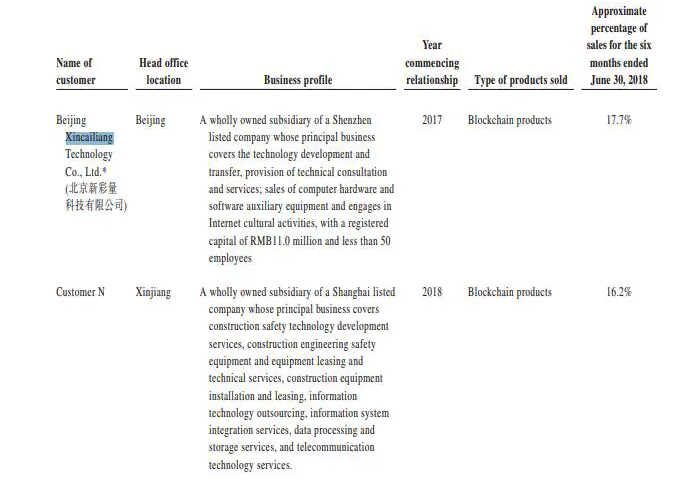
Per a prospectus from leading bitcoin mining machine manufacturer Ebang, its second largest customer, an anonymous Xinjiang-based company, is very likely to be the aforementioned Huatie HengAn, as it fits all the description shown in the prospectus. It is worth noting that its largest client, Beijing Xincailiang Tech, is a subsidiary of Shenzhen-listed technical company Wholeasy. The firm contributed 17.7 percent of Ebang’s miner sales for the first half of 2018.

Chinese Listed Companies in Bitcoin Mining Overseas: Partner or Predator?

Varied from Huatie HengAn, who apparently secretly mined bitcoin in 2018 under the guise of cloud computing, Xincailiang has built crypto mining farms overseas and offers miner host services. But public information shows Xincailiang is mainly engaged in case planning and big data traffic distribution in the field of mobile games in China.

Partner?

In August 2018, Wholeasy released an announcement that Mobcolor Technologies USA LLC, a subsidiary of Xincailiang, had reached a cooperation with California power supplier 3G Venture LLC and Singapore-based enterprise Vast Day Industry Trade Company PTE.Limited (VDIT) to “construct [a] mining center for digital cloud computing.”

According to the agreement, 3G Venture could offer 100,000 square feet for Mobcolor with a rental cost of $18 million per year and 90 MW of power capacity at $0.055/kWh, and Mobcolor’s Chinese parent company bought 65,000 mining rigs from Ebang and then resold them to VDIT who entrusted the mining operation to Mobcolor. The Chinese company’s U.S. subsidiary charged VDIT $0.075/kWh and a $24 million rental fee per year.

Having jumped on the bitcoin mining bandwagon amid the sluggish market in 2018, the company seems quite confident about the prospect of cryptomining.

Predator?

Indeed, Wholeasy is not the only Chinese listed company looking to build mines overseas.

“A plurality of bitcoin mining farms in Iran and the Middle East are run by a company named RHY, which is a NEEQ-listed Chinese company,” a miner named Ma Jingguo said.

According to its official website, RHY is a “large-scale blockchain mine.” It claims to be the largest mining company in the world, having a power supply capacity of 450 MW which could power up to 300,000 miners at the same time.

Chinese Listed Companies in Bitcoin Mining Overseas: Partner or Predator?

“In 2016, the company has invested in the construction of large-scale substations and natural gas power stations in energy-rich countries dominated by the Middle East,” Ma said. “It has become the core blockchain data center with the most competitive electricity rates in the industry. As the majority of its mines are located in Iran, #MininginIran was first hyped by the company.”

It is tough for Chinese companies to conduct bitcoin mining operations both at home and abroad, but they have advantages in capital, talent and other resources over bitcoin mining startups. Their only concern is to be compliant. In such a context, going overseas is a possible solution for them.

Considering the country is tightening its grip on cryptocurrency, these ambitious companies are making big investments overseas in bitcoin mining, a process they believe could secure better returns than crypto pump-and-dump ploys. Will they become big players in the crypto industry in the following years?

This article originally appeared on Bitcoin Magazine.


from Bitcoin Magazine http://bit.ly/2X9m7qg
via IFTTT

Hyperloop: A New Concept by Lightning Aiming to Solve Liquidity Problems

Lightning

About two months ago, Lightning Labs released Lightning Loop, a service that allows users to fill or empty Lightning channels without closing them, thus reducing on-chain fees. The service, developed by Lightning Labs developers Alex Bosworth and Bryan Vu, was created to help users manage their liquidity.

The Loop service, says Bosworth, is helpful for managing liquidity because “it sidesteps the liquidity problem for Lightning, which is that you can’t do flow rebalancing. If you run out of channel capacity in one direction, there’s no possibility that you can get more in a totally self contained, only-Lightning world. You need to go outside in order to rebalance.”

So, the natural step for users to mitigate this problem today is to perform a swap, which occurs on-chain and thus requires a transaction fee — and transaction fees on the Bitcoin blockchain can be quite substantial. With the alpha version of Loop available to the public, Bosworth and Lightning Labs had to think about how to make managing liquidity as efficient as possible.

Making Liquidity More Efficient

To address this issue, Bosworth developed a concept called “Hyperloop” as a next step toward solving this problem. Hyperloop is a concept that aggregates swaps so that individual transactions don’t occur on-chain with individualized signatures and outputs. Hyperloop batches inputs together using a method called signature aggregation.

“With signature aggregation, if you can manage to get a bunch of people all together to sign cooperatively, you can take the normal signature cost of moving funds on-chain from however many parties there are on-chain to one signature. I don’t think there’s any limitation to that.”

While this saves costs, one of the requirements is cooperation between many parties over a short period of time, which can be more challenging than it sounds.

Coordinating a Hyperloop Transaction

The Hyperloop concept mediates coordination between so many parties by essentially creating a limited-time, multiparty channel for all parties to join. So, in practice, if there were a lot of users who needed inbound liquidity, a “Loop Out” event would be created using Lightning Loop.

Lightning Loop also acts as a coordinator for these multiparty events, which solves the problem of dealing with malicious actors who might join these events with the intent to mess them up. And it does all of this in a noncustodial fashion.

While Hyperloop offers significant savings for batching the input side of multiple transactions, another big advantage of Hyperloop is savings on output scripts. “The output script, at a minimal level, is only 30 bytes,” says Bosworth. “A normal, on-chain swap is around 300 bytes. So, Hyperloop offers at least 10 times’ savings here.”

Hyperloop also allows for aggregation off-chain as well. For example, if a user has two channels, both 0.1 BTC, and wants to change the balance so that both 0.1 BTC are on the same side, they could ] accomplished this today with two swaps, resulting in two on-chain transactions. This issue of funds sitting on two separate channels can be solved through a proposal called Atomic Multipath Payments (AMPs). Without getting too technical, AMPs essentially allow a user to receive multiple transactions as if they were one, reducing the on-chain cost of sending multiple transactions to the same party.

According to Bosworth, there are two ways to approach AMPs. “Ideally it will be something that we allow with improved signatures like Schnorr, but we also have another way we can do it in the short term called ‘base AMPs,’ and this works really well with Loop.”

As such, base AMPs will be used in Hyperloop as well.

How AMPs Will Benefit Hyperloop

AMPs will benefit individual users who have many open channels. For example, if a user has 100 channels, Hyperloop can be split up between all those channels and wait for all those payments to come through before the swap is executed.

This offers a significant cost savings to another concept called “splicing,” which allows for an on-chain payment (resulting in an on-chain fee) out of a channel without requiring that the channel itself be closed. In this specific use case, a base AMP makes a lot more sense.

Upcoming developments in Bitcoin are a big consideration for all of this tech. Specifically, MuSig, a new multisignature standard that serves as a building block for technologies like Taproot, is the key to achieving these huge savings. Once Schnorr and Taproot are implemented into Bitcoin, MuSig, according to Bosworth, will be helpful in providing a protocol for safe signature aggregation.

As well, it is worth noting that Lighting Labs has also been working on signature aggregation for ECDSA, in case MuSig takes longer to implement than expected.

This article originally appeared on Bitcoin Magazine.


from Bitcoin Magazine http://bit.ly/2WcXmwJ
via IFTTT

Bullish on Bitcoin, Bearish on Trade Relations With Jeffrey Tucker

Bitcoin Magazine Podcast

Dave and Grahm are back with news and price narratives around 2019’s top-performing financial asset. This week’s stories include mainstream media’s Bitcoin FOMO, the real story of Laszlo Hanyecz (the guy behind Bitcoin Pizza Day), Dutch authorities taking down Bestmixer, Tether being partially backed by bitcoin and what Libertarian politician Ron Paul thinks about the U.S. dollar.

Also in this episode, the hosts interview Jeffery Tucker, editorial director of the American Institute of Economic Research, about how the U.S./China trade conflict might be affecting the bitcoin price.

Resources:

Be sure to subscribe to the show on the Apple podcast app, Spotify or wherever else you get your podcasts. And if you’ve got the time, please leave us a review. It really helps us improve the show and reach new listeners.

This article originally appeared on Bitcoin Magazine.


from Bitcoin Magazine http://bit.ly/2JMisve
via IFTTT

Wednesday, May 29, 2019

This Gallery Is Selling Indigenous Australian Art for Bitcoin

Art Gallery

Things you can buy with bitcoin: AT&T’s services, airfare, pretty much anything using gift cards through Bitrefill, pizza, drugs (duh) and now, Indigenous Australian art.

Yes, you read that right. The Indigenous Fine Art Gallery (IFAG) in Australia now accepts bitcoin for its “museum-quality art from Australia’s most collectible Indigenous artists.” This puts the IFAG in the company of a growing list of art galleries that accept bitcoin for their wares, but it’s the first ever to accept the cryptocurrency for art created by Indigenous Australians.

Sounds pretty niche, right? Accepting payment in the world’s first cryptographic currency for indigenous art, while it still remains difficult to purchase everyday items with bitcoin, may sound a bit too novel to be true. But, in the eyes of the IFAG, the method of payment is more novel than interest in the objects of purchase.

“This form of indigenous art is not necessarily a novelty as such,” IFAG partner David Meese wrote in an email to Bitcoin Magazine. “In fact, it has been traded as a precious commodity for the past 200 odd years, since the very first European settlements in Australia.”

For two commodities that may not appear to share much, bitcoin and Australian Aboriginal art have more in common than meets the eye. Specifically, both have seen a surge of interest in recent years and an accompanying jump in value. Figures shared with Bitcoin Magazine indicate that, over the past three decades, certain rarer pieces of Indigenous Australian art have appreciated over 600 percent per annum, an absolute moonshot in the realm of fine art.

Clifford Possum Tjapaltjarri’s Warlugulong, for instance, sold for a measly $140 AUD ($96 USD) in 1977. Thirty years later, this same artwork went for $2.4 million AUD ($1.66 million USD) at international art auction house Sotheby’s in Melbourne. Another, Emily Kame Kngwarreye’s Earth’s Creation 1, sold at the Cooee Art Auction in Sydney for $2.1 million AUD ($2.45 million USD) in 2017; 10 years earlier, in the same city, the work was auctioned for just over $1 million AUD ($690,000 USD).

According to a 2004 report for the Government of Australia Senate Committee, indigenous art sales in Australia were valued at $100 to $300 million AUD in 2002. Current figures estimate this value is now “well into the billions of dollars,” Meese states, a clear illustration of the genre’s “astonishing appreciation as an art movement.”

Meese believes that the “enthusiastic passion” infused in each piece of art, which invokes an ancestral connection to the ethereal and the physical worlds, makes them “highly infectious” as collectors’ items and so drives demand. The same motifs infused in each piece of art, though, make them more than a hot commodity; they’re also sociocultural artifacts which embody generations of Aboriginal heritage.

“Australian Indigenous art is steeped in a proud and wonderful history,” Meese said. “Each magnificent painting depicts a story or ‘dreaming’ inspired by a rich tapestry of cultures and customs … As a race of people, the Aborigines’ affinity with the earth, and respect for its elements, leaves a lot for us ‘more educated’ to ponder. They truly are at one with the land and have a definite ‘sixth sense’ or ‘additional dimension’ when it comes to the environment, the sky and the telling of dreamings through their art.”

So the art is about more than just fetching a pretty penny, Meese emphasized, and while it provides “very significant economic” benefits, it provides a wealth of “social and cultural benefits” as well.

Part of the gallery’s decision to accept bitcoin was a desire “to offer individuals all around the world a tangible and concrete investment opportunity using their bitcoin,” Meese explained, giving bitcoiners the chance to tap into a unique genre of art.

“[We wanted] to bring this beautiful, yet raw, powerful and expressive product to as many people around the world as possible,” he said. “We are big fans of Australian Aboriginal art and are very proud of this art movement and its originality and endurance. It is the oldest continuous art movement in the world and in the history of art itself.”

Meese continued to stress that each piece of art comes with “impeccable provenance” and certification to prove its authenticity. But, in the future, smart contracts and blockchains could offer even more reassurance with immutable attestations to each piece's validity. The IFAG sees great promise in blockchain technology for the future of authentication, Meese said, though it has its limits. Namely, it works better as a proactive instead of retroactive solution; case in point, you can’t rewrite authentication errors for pieces like Salvator Mundi, a $450 million painting which experts now say was likely painted by Leonardo da Vinci’s assistant and not the Renaissance man himself.

But blockchains can keep the record straight for pieces like this going forward, and Meese mentioned novel applications like allowing collectors to own a share in a piece of artwork like they might in land, stocks or other assets. Or, more probably, something like bitcoin could open up direct payment to artists, potentially rendering Meese’s job and galleries themselves obsolete, he wisecracked.

For now, though, Meese and the IFAG will focus on what they do best: selling art. He’s confident that the art’s atavistic lineage will make it an attractive investment for no-coiners and bitcoiners alike, and he’s also sure that IFAG’s pairing of cryptocurrency and art is the beginning of a sure-to-last symbiotic relationship.

“This art form has been with us for the past 60 to 80 thousand years; it has and will continue to have a longer ‘investing shelf life’ than most things,” he said. “We are confident that the art and Bitcoin can continue to grow side by side to have a very long and prosperous life together.”

This article originally appeared on Bitcoin Magazine.


from Bitcoin Magazine http://bit.ly/2WBHROB
via IFTTT

Op Ed: How Fiat Could Fall and Bitcoin Could Soar

Bitcoin Flying

Argentina’s Failed Peg

In the 1990s, the Argentine peso was pegged to the U.S. dollar. This meant that the Argentine government guaranteed that anyone could exchange one Argentine peso for one U.S. dollar. If you had 1,000 Argentine pesos in your bank account, you could walk into the bank and ask for US$1,000 and the teller would hand it over.

By 2001, the peg had become unsustainable and the government of Argentina abandoned it. As a result, the exchange rate went into freefall.

Imagine if you looked at your bank account and the value of your assets had gone down by 75 percent over the course of a year without you spending a dime. That’s effectively what happened to the citizens of Argentina in 2001.

In less than a year, the exchange rate went from 1:1 to 4:1. If you had $10,000 worth of pesos in your bank account in 2001, a year later you would have had only $2,500.

Attempts to withdraw U.S. dollars as the exchange rate plummeted were thwarted for most citizens because the run on the bank meant there were no U.S. dollars left to hand out.

I spent a year living with a retired woman in Córdoba in the 2000s who recounted to me the feeling of watching her retirement savings slashed by 75 percent as she slept on the street outside the bank, hoping to be able to withdraw it.

Though few of us who grew up in the developed world can relate, this story is not unique to Argentina in 2001.

The Debut of Paper Money

As Jack Weatherford details in his book, The History of Money, the story of fiat began in the 17th century, which marked the debut of paper money on the modern world scene. As long as this paper money was supported by some form of commodity money, like gold or silver, all seemed well. Carrying and holding paper seemed just as reliable, and far more convenient, than holding the actual precious metals that backed them.

Invariably, however, the government or bank in charge of printing the money issued more paper than it had metal to back it. Whether or not this was the “right” thing to do is a matter of debate, but once the devaluation process began, it inevitably spiraled, with more and more bills being issued at less and less value.

An analysis of fiat currencies in the 20th century found that there were 56 episodes of hyperinflation. Another study found that the average life expectancy for a fiat currency is 27 years: 20 percent failed through hyperinflation (37 currencies experience hyperinflation in the 20th century), 21 percent were destroyed by war, 12 percent were destroyed by independence, 24 percent were monetarily reformed, and only 23 percent are still in circulation.

Of those that remain in circulation, all have lost huge amounts of their original value as measured in commodity money like gold or silver. Founded in 1694, the British pound Sterling is the oldest fiat currency in existence. At the ripe old age of 325 years, it must be considered a highly successful fiat currency. Yet, the British pound was originally defined as 12 ounces of silver, so its worth today is about half of 1 percent of its original value.

The U.S. dollar was taken off of the gold standard in 1971 when it was 1/35th an ounce of gold. By 2011, it had already lost 97 percent of its value.

In his book, The Ascent of Money, historian Niall Ferguson relates that one of the main ways this seems to have happened is that rulers were forced to print money to finance wars. Once one ruler started doing this, it became a classic prisoner’s dilemma and others had to follow suit. It would be better for everyone if no one fired up the presses, but as soon as one ruler or government warmed them up, then everyone else had to keep up or they risked being conquered.

Part of the reason Germany lost World War I and suffered worse inflation of their currency than the Allies was because the German and Austrian bond market was much less developed than the French, English and American markets, which had access to far more capital. Unable to raise money through bond issuances, Germany was forced to print money faster than other powers to finance their war effort.

It’s also worth noting that in a democratic society, politicians are often unwilling to raise taxes or balance the budget because of the expected voter anger. For them, inflation and the devaluation of the currency are preferable because they constitute a hidden tax.

The consequences of poor decisions about monetary policy can take decades to show up, but politicians’ terms only last a few years — kicking the can down the road to finance their constituents and donors favorite projects is a time tested way to get elected.

When you make choices about your personal spending, you inevitably run into difficult decisions — you could take out a bigger mortgage and buy a bigger house but that would mean working an extra five years before you could retire, is that worth it? The ability to print money meant that politicians could, in effect, buy the bigger house for themselves or their constituents today and make someone else work an extra five years in the future to pay for it.

Bitcoin’s Case Against Fiat

Ultimately, all the reasons for devaluation boil down to mismatched incentives between the politicians or others in control of the monetary policy and the individuals holding the currency. Any time a system lets somebody change history with a keystroke, you have no choice but to trust that everyone who can make that keystroke will be both perfectly honest and perfectly competent. Alas, humanity, much less politicians, don’t have the best track record on either of those fronts.

When the Bitcoin network went live in January 2009, Satoshi embedded the headline of a story running that day in The London Times:

“The Times 03/Jan/2009 Chancellor on brink of second bailout for banks”

Though we can’t know for sure what was going through Satoshi’s mind(s) at the time, the most likely explanation is that Satoshi was commenting on the decisions being made in response to the 2008 global financial crisis by the small group in charge of global monetary policy. Though many people around the world were affected by these decisions, very few had any say in the matter.

Instead of impactful decisions about the monetary system, like a bailout or quantitative easing, depending on the perfect honesty and competency of a single individual or small group, Satoshi envisioned Bitcoin as a more robust monetary system, with a more distributed power structure that would make it impossible for a single individual or small group of individuals to act unilaterally.

Instead of impactful decisions about the monetary system like a bailout being reliant upon a single individual or small cabal, like the Chancellor of the Exchequer and Chairman of the Federal Reserve, Satoshi and the Bitcoin proponents that followed him, envision bitcoin as having a more distributed power structure, beyond the control of a single individual.

Viewed as money, bitcoin has many gold-like properties. We know exactly how many bitcoins will be created — 21 million — and the rate at which they will be created. Just as gold mining is limited by gold’s geological properties, the ability to change these variables in bitcoin is outside of the control of any one person or small group of individuals. This gives bitcoin a predictable stock-to-flow ratio. No single individual can decide to create twice as much bitcoin tomorrow, even if it is politically expedient.

However, bitcoin also as a few properties gold lacks. For one, it is easily divisible and transportable. Someone in Singapore can send 1/100th of a bitcoin to someone in Canada in less than an hour.

It is also extremely difficult to censor bitcoin transactions. If I have an internet connection and agree to pay the network’s fee, effectively nothing can stop me from sending bitcoin to anyone I want.

This doesn’t mean, of course, that bitcoin is not primarily a highly volatile tool of speculation today — it is — but it points to why many of those speculators are in the market. If central banks in any country fail to unwind their balance sheets gracefully and inflation sets in, savers will go looking for a safe place to store their wealth.

In this scenario, bitcoin, an easily divisible and transferable “digital gold,” may shine.

This article originally appeared on Bitcoin Magazine.


from Bitcoin Magazine http://bit.ly/2JM0PM3
via IFTTT

Five Keys to Inner Strength From Five Years in Prison

Ross Ulbricht

October 1, 2018, marked five years since I was imprisoned. My physical surroundings today are ironically similar to what they were after my arrest back in 2013. I’m in the SHU again (Special Housing Unit, aka “the hole”). It means permanent lockdown, separated from the general prison population, in a small cell. There is a slot in the heavy metal door for food trays, a small steel toilet, a concrete bunk with thick rings at four points (I guess that’s how I’ll get strapped down if I go crazy), chipped paint on the walls and floor with gang names and desperate Bible quotes etched in, and everywhere thick marks counting the days spent here by former inhabitants (some collections are terrifyingly large).

The initial shock of entering the cell — and all it meant for my immediate future — gave way after a few days to a helpless, restless dread and a burning need to get out. This feeling had to be stuffed down to avoid madness, and eventually a numb acceptance took over, but it was a precarious arrangement. Desperate frustration simmered constantly beneath the surface.

When I was first arrested, I was put in the hole against my will at three different prisons as they bounced me across the country from San Francisco where I was arrested to New York where I was prosecuted. The only reason I was given for this was that I was “high profile.” After six weeks, I was let out and never returned ... until now. This time, I’m actually glad to be here because the alternative is life-threatening.

I was forced by some other inmates to make a choice: assault someone or be assaulted. Morally I knew I couldn’t initiate violence against another, but if I refused, I would be seriously hurt and would face an uncertain future, not knowing how long I’d be in the hole under protective custody or whether I’d be sent to another prison where I’d meet the same fate.

When the dreadful situation arose, I managed to ask for protective custody before anything happened to me. I was immediately cuffed and escorted to this cell where I’m writing from. I chose the hole rather than hurt another man.

When they dropped me in the SHU after my arrest, I did my best, but it was a tough six weeks, going from a life of freedom straight in. I broke down when I got my first phone call, and, after one week, I completely lost track of time and grounding. It makes me anxious just remembering it.

Maybe after five-plus years I’m used to doing time, but I think it’s how I’ve done my time that has made me mentally tough, that has made the difference between how I handled the hole back then and how I’m handling it now. I want to share this hard-won wisdom with you. Here are the five keys to inner strength I’ve learned from five years in prison.

Patience

My first night locked up was in a San Francisco holding cell: just painted concrete, toilet and sink. There was blood splatter staining the wall. I was so impatient for that night to be over. I almost felt I couldn’t survive it, as if it would never end. Of course it did, but I’ve never felt time move so slowly.

Prison has its own pace. One time, getting two pages of medical records printed took three months. I once had a faucet running day and night for five weeks before it was fixed. A clogged toilet took two months and a complaint to the Office of the Inspector General. Another time, I spotted a letter addressed to me in the corner of a guard’s office. It had been there for four months.

I’ve learned that patience means doing what you can today then letting go. It means settling in to this moment and letting things come in their own time. Impatience and boredom do not bring results faster, but they do rob you of your happiness here and now.

Will to Fight

After a long day of working in the lab as an undergraduate research assistant back in 2005, my mentor asked me if I had ever boxed. I told him no, nor had I been in a real fight. Compared to many, I had a sheltered upbringing in safe schools and neighborhoods. I had no need to fight. He pulled out some 14-ounce gloves and we went a few rounds in the hall outside our office, blowing off steam and having fun. From then on, whenever the stress of work got high, we’d get the gloves out at night before heading home.

When I was arrested and thrown in jail, I faced an opponent in a real fight for the first time in my life. The prosecution wanted to take my life as I knew it. They wanted — and still want to — keep me in a cage forever. I found myself on an alien battlefield and my opponent had every advantage. Being initially locked up in a detention center was like fighting while under water, most of my energy going to day-to-day survival and dealing with prison bureaucracy.

At trial, I stepped into the ring hoping for a chance, for a fair fight. When my lawyer wasn’t allowed to cross-examine the prosecution’s witnesses and I wasn’t allowed to call my own, my hands were tied behind my back. And when the prosecution was allowed to hide corrupt agents from my jury and present unreliable and tainted digital evidence, they were handed a metal bat. It wasn’t a fight. It was a massacre. The defeats kept coming, first at the appellate court, then at the Supreme Court.

I remember one time when I decided to stay out late on the prison yard. The sun was setting, and it was just me and a few others out there. I walked over to a metal picnic table where a man I’ll call Big Mike sat alone. Big Mike was the biggest person I’ve ever met. He weighs twice as much as I do, and his arms are as thick as my legs. He once told me that he doesn’t work out because he gets too big and scares people. We chatted for a while and he told me about the arguments he was preparing for his next motion to the court.

“I need to keep working on my case every single day until I go free,” I said, inspired by his efforts.

His expression became stern. He stared me down then went into a half hour rant that only ended because we were called off the yard for the night. “Yes you do,” he said. “No one is going to fight for your freedom like you. These people got you tied in a knot and you’ll never get out if you don’t struggle and fight. You’re fighting for your life. They took your life from you. Only you can get it back.” He was still going as we walked into the cell block.

Big Mike had fought his entire life. He grew up on the streets of Philly. He fought to survive, and now he was fighting the last shreds of doubt and defeat still left in my heart. He won that night and lit a fire in me that’s been burning ever since.

The will to fight is primal. It’s in all of us. Like me, many of us have never needed it and it lays dormant. Yet you don’t need to wait until you are under attack and your life is in danger to learn to fight. You can fight for who you love, for what matters, for what you believe in, like your life depends on it. And truly it does because a life worth living is worth fighting for.

Forgiveness

A few months after I was sentenced, I lay down on my bunk after the cell door had been locked for the night. As my conscious mind slowed down and sleep approached, the faces of those who put me away for life bubbled up and captured my attention: the judges, prosecutors, politicians and agents, and they were looking down on me with mocking smiles. A cocktail of emotions accompanied these images, including anger, frustration, helplessness, even the beginnings of hate. My heart beat fast and my mind raced until I snapped fully awake and lay there trying to drift off again. After a few cycles of this, I sat up in bed. This wasn’t the first time I couldn’t stop these negative feelings. I had to get a grip.

While I was tossing and turning, those people were probably sleeping, comfortable and sound, in big comfy beds in big comfy houses. Or were they? Maybe they were also sitting up at night tormented by the thought of all the people like me they had condemned. Or maybe they didn’t care and rationalized the pain away. The truth, I realized, was that I had no idea. And further, all my anger wasn’t hurting them one bit. It was all right there with me in that cell. I wasn’t getting back at them by holding a grudge, but I was poisoning my mind.

As revolting as it felt at first, I had to forgive them. I purposely cultivated thoughts like “It wasn’t personal, they don’t even know me” and “Their hearts must be so calloused by what they do, I feel sorry for them.” I focused on feelings of love and kindness and imagined them radiating out and healing those who had hurt me. I don’t know if that had an effect on any of them, but I certainly started sleeping better.

As time went on, I became ruthless with these hateful thoughts whenever they entered my mind and would rewire them immediately as I had that night. I could not indulge in them because I had come to learn this simple truth: hate does not hurt the hated, it hurts the hater. It’s been years since I wasted my energy hating those people and I’m so much better off for having forgiven them.

Faith

Being condemned to grow old and die in prison with two life sentences plus 40 years is like staring into an abyss. My future as I knew it disappeared, replaced by darkness and uncertainty. In the face of this nightmare, faith became a matter of survival.

The day I was sentenced I returned to the detention center and was given hugs, condolences and a hot meal from my fellow prisoners. When I found some time alone that night, I saw two roads before me. One was a downward spiral. I could see that the further I went down, the harder it would be to claw my way back. At the bottom, the demons of despair, hatred and crushing sadness were waiting to devour me. The other path soared upward, but I couldn’t find the steps. There weren’t any. There was no reason to hope that I could hold onto.

In the following months, I had to leap, stumble and scramble toward that upward path. With all evidence to the contrary, I had to have faith that God would see me through whatever was to come. I realized I’m not strong enough on my own to keep from falling into that ever-present abyss. It may be irrational to believe without proof, to have faith, but it’s also irrational to forsake the hope, love and joy that faith brings, because it gives you the strength to fight and ultimately win. In a situation as desperate as mine, keeping faith alive is the difference between freedom and a slow, caged death.

Acceptance and Gratitude

There are endless opportunities for suffering in prison. You can suffer when they lock you in the cell and you feel like you’ll explode if you can’t get ou; when your back spasms from the hard bunk; when you’re sick and feel isolated; when you notice the filth; when the door slams and locks behind your loved ones after a visit; when you feel like you’re drowning and just need one last day of freedom to breathe; when you wish you could keep sleeping but you have to get your boots on because what if a riot pops off; when you imagine the shank you saw pierce the last man is piercing your flesh; when you realize you haven’t had a moment of privacy in years and everything around you is cold and hard; when someone dies and you never got to say goodbye to.

I’ve had countless occasions for suffering. In each case the pain is unavoidable. It hits without warning and you feel it, whether you like it or not. And of course, the nature of pain is to not like it. Our natural reaction is to resist it, to fight it, to push it away or down. This aversion to pain is suffering.

To resist what is so and long for something better is to suffer. Pain and suffering seem hopelessly entangled in prison, but I’ve learned that suffering is not the unavoidable consequence of pain.

While pain is inevitable in my circumstances, suffering is entirely optional. Pain, even emotional pain, is just a physical sensation: the knot in my stomach, the ache in my heart and head. It is neither positive nor negative on its own. It just is. Suffering is our negative response to pain which compounds and amplifies it and drags it on and on.

I’ve come to believe that the antidote to suffering, the path out of it, is acceptance and gratitude. Acceptance turns “I can’t take another day in this hell” into “I am where I am, and yes, it hurts.” Gratitude goes a step further: “At least I have clean water and enough food. At least I’m alive and surviving. Thank you.” Suffering always arises in the context of inadequacy because you want what you don’t have. Acceptance and gratitude flip your context to one of abundance because you are focused on what you do have and are thankful for it. It’s the difference between misery and joy and it’s available to each of us every moment of the day.

So here I am in the hole, counting my many blessings and refusing to indulge in suffering. Hopefully, you can benefit from these five keys to inner strength without having to go through what I have. That would be a nice silver lining, to know what’s happened to me can make a difference for you. That is one more thing to be grateful for.

This article originally appeared on Bitcoin Magazine.


from Bitcoin Magazine http://bit.ly/2KbKYWS
via IFTTT

Cartoon: Driving Sheep

Cartoon: Driving Sheep

Industry regulators are finally catching up with blockchain companies that have dubiously defined their tokens as "utilities" (therefore avoiding the strict issuing and management requirements of "securities"). The U.S. Securities and Exchange Commission has publicly brought a number of enforcement actions against over 20 such companies and individuals, which is encouraging the rest of the blockchain industry to step back into line.

This article originally appeared on Bitcoin Magazine.


from Bitcoin Magazine http://bit.ly/2wnJsIS
via IFTTT

Cryptopia Turns to a U.S. Court for Account Holder Data Protection

Cryptopia

In the latest development over its security breach, cryptocurrency exchange Cryptopia has filed for bankruptcy protection in the U.S.

The New Zealand-based exchange, which has been dealing with the fallout of a January 2019 hack, went into liquidation and stopped all trading earlier this month. Cryptopia's assigned liquidator, Grant Thornton, then petitioned the Southern District of New York’s bankruptcy court to seek recognition of this liquidation and protect exchange data stored on servers by a firm in Arizona.

Per a report from Bloomberg, the unnamed firm had terminated its agreement with Cryptopia and was seeking $2 million in compensation for its services. Cryptopia's liquidators secured the bankruptcy order from the Southern District of New York, ensuring that the firm's data are intact through a provisional relief that will last until June 7, 2019.

“The interim order preserves the Cryptopia data, which includes a SQL database containing all account holders’ individual holdings of cryptocurrencies and the account holder contact details,” the update from Grant Thorton reads. “Without this information, reconciling individual holdings with the currencies held by Cryptopia will be impossible.”

This development closely follows news that Cryptopia’s founder has launched a new exchange.

This article originally appeared on Bitcoin Magazine.


from Bitcoin Magazine http://bit.ly/2Wv288m
via IFTTT

Tippin Enters Version 1.0, Promising New Feature

Lightning

Lightning Network app Tippin.me has released a version 1.0 update, which includes a host of new features and promotional measures intended to increase the user base and improve the user experience.

Originally launched in December 2018, Tippin was introduced as a novel way to use the Lightning Network to make micropayments easily accessible for a wide range of users by allowing them to send and receive tips over the Lightning Network on Twitter. Originally a custodial wallet solution, the app is particularly noteworthy in that it is the work of one developer, Sergio Abril.

Within the first several months of the app’s launch, Tippin quickly rose to relative prominence in the crypto space. By March 2019, Tippin began accruing roughly 200 users daily, with a total user base of around 14,000, and even got a shoutout from Twitter co-founder Jack Dorsey.

On May 23, 2019, Tippin’s official Twitter account announced the release of version 1.0, officially leaving the app’s beta stage of development. The update includes a variety of quality-of-life features that allow users to perform more actions directly through their profiles. Now, users can check balances from the extension, tip directly from their balances, attach messages to transactions and top up their accounts by sending bitcoin from an on-chain wallet.

The announcement claims that “now it’s even easier to tip people” and is offering an added bonus of 1,000 satoshis to new users who sign up within a limited time. Veteran users who refer new users to the platform will also receive 500 satoshis for each new customer they attract.

This article originally appeared on Bitcoin Magazine.


from Bitcoin Magazine http://bit.ly/2EDqRNF
via IFTTT

Saturday, May 25, 2019

Infographic: An Overview of Compromised Bitcoin Exchange Events

Bitcoin Exchange Events Infographic

The purpose of this infographic is to visualize the size of large cryptocurrency hacks that have occurred in the past as if they all happened today. The hacks included in this infographic extend beyond exchanges, as there were other large entities that experienced cryptocurrency hacks, such as marketplaces like Silk Road 2.0. All hacks in this infographic are displayed as if the price of bitcoin was the same when they occurred, in order to visualize their magnitudes in relation to one another.

The x-axis shows the price of bitcoin at the time of the hack. The y-axis shows the amount lost in the hack (converted to BTC for altcoin hacks). The size of each hack circle was determined by the value of BTC lost using a consistent price, regardless of the actual price at the time.

It is important to note that several of the exchanges (rendered in green) were hacks that did not necessarily involve bitcoin or exclusively involve bitcoin.

An Overview of Compromised Bitcoin Exchange Events

Mt. Gox

Hack Dates: June 2011, February 2014

Amount Lost: 790,000+ BTC

In March 2014, Mt. Gox declared bankruptcy due to a series of hacks and thefts that went unreported for over three years, which were later documented by blockchain analyst Kim Nilsson. The final collapse resulted in a crash of Bitcoin in 2014. Below is a summary of all meaningful hacks that occured.

On March 1, 2011, 80,000 BTC were stolen from Mt. Gox’s hot wallet, as thieves were able to make a copy of the wallet.dat file. In May 2011, hackers stole 300,000 BTC temporarily stored on an off-site wallet, which was on an unsecured, publicly accessible network drive. However, shortly after, the thief got nervous and returned the stolen funds with a 1 percent (3,000 BTC) “keeper’s fee.” In June 2011, a hacker was able to get into Jed McCaleb’s administrator account and manipulate prices, temporarily crashing the market. After the ordeal was over, the hacker managed to steal 2,000 BTC.

In September 2011, a hacker was able to get read-write access to Mt. Gox’s database. The hacker created new accounts on the exchange, inflated user balances and was able to withdraw 77,500 BTC, after which they deleted most of the logs containing evidence of such transactions. In October 2011, a bug in Mark Karpeles’ new wallet software caused 2,609 BTC to be sent to an unspendable null key. The largest hack occurred at some point between September and October 2011 when a hacker was able to obtain a copy of Mt. Gox’s wallet.dat file and stole 630,000 BTC.

Bitcoinica

Hack Date: March 1, 2012

Amount Lost: 43,000 BTC and then another 18,457 BTC

Web hosting provider Linode’s servers were hacked, granting access to the bitcoin stored on pioneering exchange Bitcoinica. The incidents ultimately led to the demise of Bitcoinica.

BitFloor

Hack Date: September 2012

Amount Lost: 24,000 BTC

BitFloor was compromised when a hacker was able to access unencrypted backups of the exchange’s wallets and transfer out the coins.

Poloniex

  • Hack Date: March 4, 2014
  • Amount Lost: 97 BTC
  • In March 2014, Poloniex announced that it has been the victim of an attack due to a previously unknown vulnerability in its coding. As a result, the exchange told all of its customers that it would have their account balances reduced by 12.3 percent.

Bitstamp

Hack Date: January 2015

Amount Lost: 19,000 BTC

Hackers were able to access Bitstamp’s hot wallet. As a result of the theft, Bitstamp began to keep 98 percent of its bitcoins in cold storage.

Cryptsy

Hack Date: July 2014

Amount Lost: 13,000 BTC

In early 2016, Cryptsy collapsed following the theft of 13,000 BTC (and 30,000 LTC) from customers’ wallets.

Bitfinex

Hack Date: August 2016

Amount Lost: 120,000 BTC

Attackers were able to exploit a vulnerability in the multisig wallet architecture of Bitfinex and blockchain security company BitGo.

QuadrigaCX

Shutdown: January 15, 2019

Amount Lost: Approximately $190 million in BTC, ETH and CAD (at time of publication)

The co-founder of QuadrigaCX died on December 9, 2018, allegedly as the only one with access to the exchange’s keys. Evolving courtroom proceedings have revealed fund mismanagement and potential fraud on the part of the exchange. This has led to calls for greater oversight of exchange operations.

2018’s Cluster of Mishaps in Asia

A cluster of hacks and mismanagement of funds by exchanges in 2018 occurred as the result of minimal regulation and security precautions. Consequently, some exchanges were forced to close operations entirely while others received fines.

Coincheck (Japan)

Hack Date: January 2018

Amount Lost: 523 million NEM

Coinrail (South Korea)

Hack Date: June 2018

Amount Lost: $40 million in various cryptocurrencies

On July 15, 2018, Coinrail resumed trading and offered the victims two compensation options: a gradual refund through the purchase of stolen cryptocurrency or compensation in Coinrail’s RAIL tokens, which could then be converted into another cryptocurrency at an inner rate.

BitHumb (South Korea)

Hack Date: June 2018

Amount Lost: $30 million in various cryptocurrencies

The successful hack of BitHumb occurred shortly after the exchange updated its security systems following an earlier hack in 2017.

Decentralized Exchanges

Bancor

Hack Date: July 9, 2018

Amount Lost: $23 million (mostly in ETH)

Hackers were able to gain control of a Bancor exchange wallet and transfer out funds.

BitGrail

Hack Date: February 21, 2018

Amount Lost: $170 million in XRB, now NANO

Following this hack, authorities in Florence confiscated all of the cryptocurrency from the Italian exchange BitGrail to secure the claim of affected users, and the Nano Foundation promised to assist in the protection of interests and compensation for losses. Users accused the exchange of having lax security.

MyBitcoin

Hack Date: July 2011

Amount Lost: 78,739 BTC

Little information was released about the MyBitcoin theft, however, many argue that operator Tom Williams ran it as a scam. The theft resulted in the closure of MyBitcoin, which was once a successful Bitcoin company in the cryptocurrency’s early days.

Bitomat.pl

Hack Date: July 27 2011

Amount Lost: Approximately 17,000 BTC

During a server restart, the remote Amazon service that housed Bitomat.pl’s wallet was wiped. No backups were kept and Mt. Gox later bailed Bitomat.pl out. Ultimately, neither exchange customers nor original owners suffered any loss from the incident.

Evolution Darknet Marketplace

Hack Date: March 2015

Amount Lost: Approximately 44,000 BTC

In March 2015, Evolution Marketplace administrators “Kimble” and “Verto” were suspected of unexpectedly shutting down Evolution, a darknet marketplace that appeared after the seizure of Silk Road 2.0, and vanishing from the internet with all user funds.

Silk Road 2.0

Hack Date: February 2014

Amount Lost: Approximately 4,400 BTC

Defcon, an administrator at underground marketplace Silk Road 2.0, noticed that funds held for the escrow service were stolen from a hot wallet in February 2014. “Transaction malleability,” an issue with the Bitcoin protocol at the time that also affected some other services, was blamed for the theft, though many suspect it was an inside job.

This article originally appeared on Bitcoin Magazine.


from Bitcoin Magazine http://bit.ly/2VNgRHo
via IFTTT

LocalBitcoins Denies Service to Iranian Users

LocalBitcoins

The popular peer-to-peer bitcoin trading network LocalBitcoins has shut down all trading operations for Iranian users.

LocalBitcoins’ website offers a variety of pages for users of different nations and, as of May 24, 2019, the Iranian page displays a message that “LocalBitcoins is currently not available in your selected region,” in English only. In an official correspondence regarding the update, a representative of LocalBitcoins confirmed that Iranians can no longer access the service.

“If you have an account already, you will be able to withdraw your bitcoins, but you will not be able to use the platform for trading,” the representative said of Iranian users.

LocalBitcoins is not the first peer-to-peer trading network to block Iran in this fashion. Major companies such as Coinbase and Binance have also begun rejecting Iranian customers on the basis of their nationality within the past year. Ziya Sadr, an Iranian bitcoiner, told Bitcoin Magazine that the move “shouldn't come as a surprise.”

The reason for these companies’ blocks seems clear: the new wave of sanctions that the United States is levying against Iran and companies that conduct business within the country. Since the Trump administration unilaterally violated an agreement with the Iranian government regarding the nonproliferation of nuclear weapons in 2018, relations between the two countries have been deteriorating.

Iranian citizens have shown interest in the borderless nature of Bitcoin for just this reason, among the other natural advantages of the technology. In April, the country’s first Bitcoin ATM made a splash at a Tehran technology exhibition. Camera crews interviewed several passersby and the topic of using Bitcoin to circumvent unjust sanctions came up repeatedly.

Bitcoin is fundamentally a platform designed to connect users worldwide, regardless of the restrictions imposed on free exchange by various nations. After receiving the Lightning Torch from Bitcoin Magazine via Welsh bitcoiner Bitgeiniog in March, Sadr called Bitcoin “a safe haven.”

“Laws and regulations may force a business to take decisions against their will,” Sadr told Bitcoin Magazine regarding the LocalBitcoins ban. “This will force a business like LocalBitcoins to lose users and revenue, but the market operates and there will always be different business that will serve us.”

Indeed, the space as a whole is not abandoning the country of some 80 million people. Also on May 24, Hodl Hodl announced that it was offering full support for operations in the country. More than just keeping the site open, Hodl Hodl also announced that it would provide Farsi language support (unlike LocalBitcoins’ English-only error message), a discounted exchange fee and a Telegram group specific for Iranian users to establish contact with each other. Bisq, another decentralized bitcoin exchange, has also added Farsi support and offers Iranian bitcoiners a viable alternative.

Ironically, even in the wake of LocalBitcoins’ exit from the country, Iranians “actually now have more and better options for p2p exchanges than before,” Sadr said.

This article originally appeared on Bitcoin Magazine.


from Bitcoin Magazine http://bit.ly/2YG9QtA
via IFTTT

Friday, May 24, 2019

Bitcoin Price Analysis: Macro Resistance Could Push Price Down to $6,000s

Price Analysis Video.jpg

Summary:

  1. The bitcoin market is seeing some pullback as the monthly and weekly resistance level has proven to be a tough level to crack. On the daily level we can see a couple of attempts to break the level, but ultimately this was matched with strong selling pressure.
  2. On bitcoin’s four-hour chart we can see that support that once held the market up is now turning into support with a failure to reclaim the level.
  3. If we fail to reclaim the $7,800s, we can expect to see a retest of the $7,300s and if that level doesn’t hold, we will very likely see a test of the low $6,000s.

Trading and investing in digital assets like bitcoin is highly speculative and comes with many risks. This analysis is for informational purposes and should not be considered investment advice. Statements and financial information onBitcoin Magazine and BTC Inc sites do not necessarily reflect the opinion of BTC Inc and should not be construed as an endorsement or recommendation to buy, sell or hold. Past performance is not necessarily indicative of future results.

This article originally appeared on Bitcoin Magazine.


from Bitcoin Magazine http://bit.ly/2HyP2i4
via IFTTT

AT&T Now Accepts Bitcoin

AT&T News Bit

AT&T customers can now use bitcoin to settle their bills online.

According to a press release from the Dallas-based mobile carrier, customers who want to use cryptocurrency to pay their bills can do so by selecting BitPay as a payment option on the myAT&T app or when they log in to their account. BitPay is a popular crypto payment service that helps businesses accept cryptocurrencies for payments online.

“It's exciting for BitPay to support AT&T as it moves to accept bitcoin as a payment option,” Sonny Singh, BitPays chief commercial officer, told Bitcoin Magazine. “Bitcoin lets customers pay from anywhere in the world quickly and easily.”

For AT&T’s part, adding BitPay as a payment option gives its customers more flexibility.

“We’re always looking for ways to improve and expand our services,” said Kevin McDorman, vice president of AT&T’s Communications Finance Business Operations, per the release. “We have customers who use cryptocurrency, and we are happy we can offer them a way to pay their bills with the method they prefer.”

This article originally appeared on Bitcoin Magazine.


from Bitcoin Magazine http://bit.ly/2HyNSTx
via IFTTT

Founder of Defunct Cryptopia Launches New Crypto Exchange

Cryptopia

The founder of defunct cryptocurrency exchange Cryptopia, which entered liquidation following a hack in January 2019, has launched a new exchange called Assetylene.

The LinkedIn employment history for the founder of the failed New Zealand exchange, Adam Clark, indicates that he’s been working on Assetylene since September 2018, which is also when the exchange’s Twitter account went live. With fewer than 100 followers, the account is billed as representing “New Zealand’s most advanced crypto-currency exchange [sic].”

Once a highly prominent exchange in New Zealand, Cryptopia lost nearly 10 percent of its entire liquidity in a hack earlier this year. Attempts to salvage the business ultimately failed. On May 15, 2019, its liquidators formally announced that the company was defunct. At the time of this writing, hundreds of thousands of dollars worth of Cryptopia’s assets are still circulating in an easily tracked manner.

Seeing as Cryptopia did not fully close until May 2019, and Assetylene’s date of founding is listed in the preceding September, it may be that Clark had moved on to this new business well before Cryptopia’s collapse began. However, there’s also reason to believe that Clark set up the new exchange quickly, after Cryptopia’s hack had already occurred.

For one, an archived copy of the Assetylene site shows that it is based on the TradeSatoshi platform, which can set up exchanges within minutes. Furthermore, Clark’s own LinkedIn shows that he was TradeSatoshi’s senior software development engineer when Assetylene was first set up. More damningly, Assetylene has zero liquidity, is not listed on CoinMarketCap and its about page is empty with no trading data found on the site.

Assetylene may very well become a full-fledged exchange with time. However, given the time period that it has apparently remained inactive while Cryptopia was still viable and its current insufficiency, the jury’s still out.

This article originally appeared on Bitcoin Magazine.


from Bitcoin Magazine http://bit.ly/2Wh8yrD
via IFTTT

Coinme and Coinstar Expand Bitcoin Kiosk Service

Coinstar Coinme News Bit

More crypto users can now walk into their local grocery store and purchase cryptocurrencies, thanks to the expansion of a partnership between Bitcoin ATM operator Coinme and coin-cashing machine purveyor Coinstar.

The expansion, announced in a press release, means that bitcoin will be available for purchase at over 2,200 locations in 21 states and the District of Columbia. The partnership began in early 2019 and grew to offer bitcoin purchases at kiosks in 19 states in late April.

Specifically, the kiosks allow users to enter their phone numbers and deposit cash in exchange for bitcoin redemption codes, which can be redeemed on Coinme’s website with an account. Users can purchase up to $2,500 worth at a time and are subject to a 4 percent flat fee.

This article originally appeared on Bitcoin Magazine.


from Bitcoin Magazine http://bit.ly/2M2Xkmw
via IFTTT

Featured Post

BITCOIN (BTC) blockch✂️ain FORKS

🚧🛑🚧🛑🚧🛑🚧🛑🚧🛑🚧🛑🚧🛑🚧 Bitcoin Cash:  Forked at Block 478558, 1 August 2017, For each 1 BTC you get 1 BCH Bytether:  Cross for...